
Therefore Document Management: A UK Buyer's Guide to Canon's ECM Platform
Most UK organisations still run on documents — invoices, contracts, HR files, signed forms, scanned correspondence. The volume keeps growing, but the way people find, approve and retain those documents often hasn't changed in years. Therefore, Canon's enterprise content management platform, is one of the more credible answers to that mess.
This guide explains what Therefore document management actually is, where it fits, what it does well, and how to decide whether it belongs in your environment. It's written for UK operations directors, finance leads, HR managers and IT teams who are tired of paper-shuffling but wary of being sold a platform that needs an army to run.
We'll cover the core capabilities, a UK compliance view, a practical implementation checklist, and the common pitfalls to avoid — without the marketing gloss.
What Therefore document management actually is
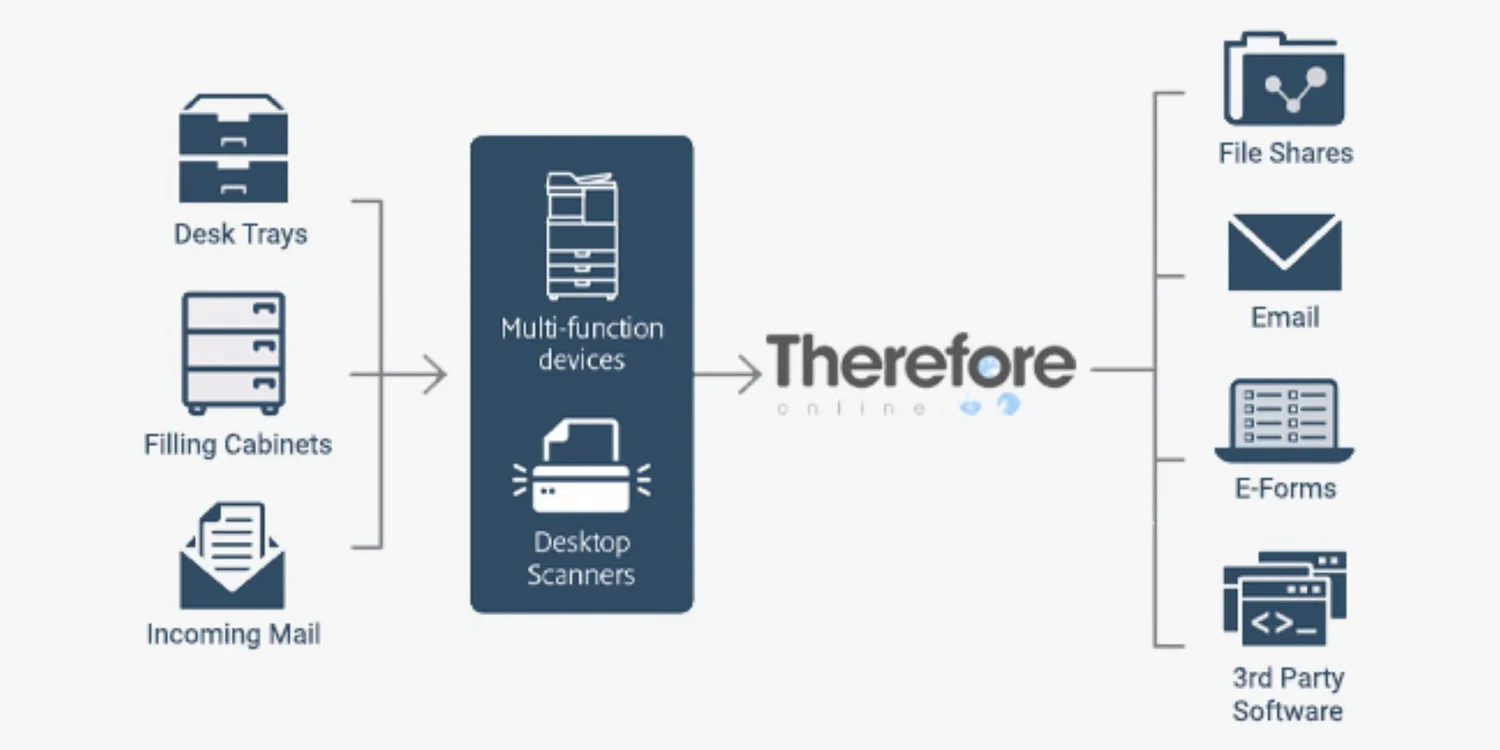
Therefore is an enterprise content management (ECM) platform built by Canon's software division. It does five things that, taken together, replace the patchwork of shared drives, paper trays and email approvals most organisations rely on: it captures documents from any source, stores them in a secure central repository with metadata, manages workflows and approvals, controls retention and access, and reports on what's happening across the system.
The platform was recognised as a leader in SoftwareReviews' 2024 Enterprise Content Management Data Quadrant Report, with a composite score of 9.0 out of 10 — the second consecutive year it earned that recognition. End users gave it 86% satisfaction overall, with workflow process automation scoring 91% and search 89%. Those numbers matter, because ECM platforms live or die on whether people actually use them.
Where most businesses start: the trigger is rarely "we need ECM". It's usually a specific pain — a finance team drowning in supplier invoices, an HR team that can't find a leaver's file, a contract that auto-renewed because no-one tracked the expiry, or an ICO subject access request that took three weeks to fulfil. Therefore is built to fix those operational problems first, and the broader compliance and visibility benefits follow.
The four principles that make ECM worth doing
Before looking at features, it's worth being clear about why document management projects succeed or fail. The platforms that deliver share a few characteristics — and the implementations that stall almost always missed one of these from day one.
Frameworks like AIIM's intelligent information management model, ISO 15489 records management and the ICO's UK GDPR guidance all build on these ideas. The detail varies, but the underlying logic doesn't.
The core capabilities, broken down
Therefore is modular, which matters because most UK SMEs and mid-market organisations don't need everything on day one. The platform groups its features into six functional areas — capture, manage, access, automate, analyse and secure — and you can deploy them progressively as use cases mature.
Scan from Canon, Konica Minolta, Sharp or Epson MFDs; watched folders and monitored mailboxes; native Microsoft 365 and Outlook integration; web-embedded e-forms; AI classification via Azure Document Intelligence.
Version control with full change history; simultaneous collaboration; case management for grouped records; retention policies aligned to document class; connectors for SAP, Dynamics 365 and SharePoint.
Installed application, web client and mobile (Therefore Go); offline editing via Therefore Anywhere; external portal for client and supplier collaboration; full-text and metadata search across the repository.
Workflow engine for approvals, routing and escalation; Smart Capture extracts data from invoices automatically; Content Connector ingests from watched sources; API, Web API and Universal Connector for bespoke needs.
Scheduled reporting; audit trails on every document and user action; real-time dashboards on workflow performance, document volumes and approval bottlenecks.
Role-based permissions; encryption in transit and at rest; anti-tamper verification on retrieval; full audit logging; independently audited for UK and EU GDPR compliance.
Where Therefore earns its keep, by department
The platform is process-agnostic — you configure it around your own workflows rather than bending the business to fit the software. That said, there are repeatable use cases where the ROI shows up fastest, and these are usually the right starting points for UK customers.
| Department | Typical use case | What changes |
|---|---|---|
| Finance | Accounts payable invoice processing | Invoices captured by email or scan, data extracted automatically, matched to PO, routed for approval, posted to the ERP. Touches drop from minutes per invoice to seconds. |
| HR | Employee records and onboarding | Right-to-work documents, contracts and reviews held in a permissioned employee case file. Onboarding triggers automatically; leaver retention rules enforce GDPR storage limits. |
| Operations | Quality records, SOPs, training certificates | Controlled documents replace shared-drive sprawl. Version history is auditable; training expiries surface before they lapse. |
| Legal & Contracts | Contract lifecycle and e-signature | Contracts stored against client/supplier metadata with renewal notifications. Auto-renewals stop being a surprise; signed copies route to the right binder automatically. |
| Customer service | Case files, complaints, correspondence | All communication grouped by case. Agents see the full history without inbox archaeology; SLAs are tracked in workflow. |
How Therefore fits different organisations
One of the practical questions any IT lead asks is: "Will this actually work for us, or is it overkill?" Therefore is deliberately modular — the deployment looks very different for a 30-person finance team than for a 500-person multi-site organisation, and a good implementation should adapt rather than dictate.
The starting point for most UK SMEs. A single department — typically accounts payable, HR onboarding or contract management — moves a clearly defined process onto Therefore. Scope is narrow, success criteria are measurable, and the rollout proves value before any wider commitment.
Once the first process is bedded in, the same platform extends across the business. Each department gets its own document classes, metadata schema and workflows, but everything sits in one repository — so a leaver's file links to the same person's signed contract, and finance approvals reference the originating purchase order.
The most demanding deployments. Therefore becomes the system of record for documents across a multi-site or international organisation, with deep integration to SAP S/4HANA or Dynamics 365, advanced case management, and tight compliance evidencing for ISO 27001 or sector-specific regulators.
Why this matters: too many ECM platforms force a single deployment model on the customer. Therefore meets your business where it is today and supports the architecture you'll have in two or three years' time. If a provider can't tell you which tier your environment matches, that's a useful question to put to them.
The UK compliance picture
If your organisation handles personal data — and almost every UK organisation does — document management is a UK GDPR question, not just an efficiency one. The ICO's seven data protection principles translate directly into document-platform capabilities.
| UK GDPR principle | What Therefore provides |
|---|---|
| Integrity and confidentiality (security) | Granular role-based permissions, encryption in transit and at rest, anti-tamper checks on document retrieval, full audit logs of every access and edit. |
| Storage limitation | Class-level retention schedules that auto-purge or anonymise personal data when the lawful holding period ends. |
| Accountability | Audit trails on every document action — who accessed, viewed, edited, exported — exportable for ICO subject access requests. |
| Accuracy | Version control with full history; users can only act on the current authoritative version. |
| Data minimisation | Permissions can restrict access to specific metadata fields, supporting need-to-know access on sensitive records. |
Therefore has been independently audited to confirm it enables clients to meet the data protection requirements set out in the EU and UK GDPR. That doesn't make any platform compliant by itself — compliance is always about how you configure and use it — but it provides the technical control surface that compliance teams need.
Worth knowing: the NCSC's 10 Steps to Cyber Security guidance and the Cyber Essentials scheme both call out access control and data security as foundational. A properly configured ECM contributes directly to both — it's one of the easier ways to demonstrate evidenced control over personal and commercial data in a Cyber Essentials Plus assessment.
The practical implementation checklist
The single biggest reason ECM projects fail isn't the software — it's scoping. Start narrow, prove value, expand. These are the controls and decisions, ordered by impact, that separate successful Therefore deployments from the ones that drift.
Usually accounts payable or HR onboarding. Get it working end-to-end before adding the next.
Decide what every document of each class must be indexed by — supplier, date, ID, status — before go-live.
Work with your DPO. Define the lawful basis and retention period for each document class up front.
Scan-to-Therefore from existing devices removes the most common friction point on day one.
Tie permissions to Active Directory or Entra ID groups so access reflects role changes automatically.
Bring legacy archives in selectively. Old scans without metadata add noise, not value.
Get capture and storage right first. Automation only delivers when the underlying records are clean.
One department at a time, with super-users embedded. The 86% satisfaction figure assumes the rollout was done properly.
Common mistakes to avoid
The same handful of issues come up again and again in document management projects. None of them are technology problems — they're decision problems made before the platform is touched.
- Treating it as an IT project. ECM only succeeds when the process owners — finance, HR, operations — drive the design. IT delivers the platform; the business defines the rules.
- Replicating folder structures in the new system. If you import shared-drive folders one-for-one, you've digitised the mess. Redesign around metadata before migrating anything.
- Skipping retention policy design. Without it, you'll hold personal data forever, breach the storage-limitation principle, and accumulate risk you don't need.
- Over-customising the workflow engine on day one. Start with the standard approval patterns. Add complexity only when the operational evidence demands it.
- Buying licences without budgeting for change management. User adoption is where ROI lives. A two-day training plan won't get you there.
- Ignoring the scanning hardware. Capture quality at the MFD determines everything downstream — OCR accuracy, classification, automation success rates.
How Syncro builds Therefore into your environment
Most of our clients don't come to us asking for "enterprise content management" — they come to us asking how to stop chasing invoice approvals, find HR records faster, or pass their next compliance audit. The document management work happens alongside that, because a properly designed managed print and document service builds the controls in by default.
Syncro is independent. We work with Canon, Konica Minolta, Epson and Sharp, and our recommendations are shaped by what fits the customer rather than by a manufacturer commitment. That independence matters when the conversation moves from print volumes to document architecture — because not every manufacturer offers the same depth of capability when it comes to integrated capture and ECM.
Why we lead with Canon for document management
For customers whose document workflows sit at the centre of how the business operates — finance teams processing high invoice volumes, regulated industries with strict retention requirements, organisations moving toward fully digital records — Canon's combination of hardware and Therefore is genuinely differentiated.
Therefore is built by Canon, not bolted on. The capture path from a Canon imageRUNNER MFD straight into Therefore is native — no third-party connector, no separate licensing for the scan workflow, no integration drift when one product updates. For finance teams scanning hundreds of invoices a week, that integration matters.
Independent leadership recognition. SoftwareReviews has named Therefore an ECM leader two years running, with an 86% end-user satisfaction score — eight points clear of DocuWare on vendor support and ahead on every critical feature including workflow automation and search.
Cloud, on-premises or hybrid — the customer chooses. Many UK customers want cloud for speed of deployment and infrastructure simplicity. Others, particularly in regulated sectors, need data on UK soil or inside the corporate network. Therefore supports all three without a different product or a different licence.
For customers whose priorities are different — a simpler departmental need, an existing investment in another platform, very specific workflow requirements — Konica Minolta's Dispatcher, Sharp's Synappx or another option may be the better recommendation, and we'll say so. Independence works both ways. But on integrated capture-to-ECM specifically, the Canon-plus-Therefore combination is hard to match.
Beyond the technology
Software and hardware only do their job when they're managed properly. Metadata schema reviews, retention policy updates, user training as teams change, certificate renewal, integration testing when ERPs upgrade — these aren't add-on services. They're part of how a managed document service should run, and they're what separates a platform that delivers from one that becomes shelfware after twelve months.
If you're scoping a document management project, a free document audit will tell you exactly where your current environment stands, what the quick wins are, and in what order to tackle them. We offer this with no obligation and no commitment to switch provider.
Syncro is independent and works with Canon, Konica Minolta, Epson and Sharp. For integrated capture-to-ECM specifically, we recommend Canon imageRUNNER hardware combined with Therefore — named a SoftwareReviews ECM leader two years running, with an 86% end-user satisfaction score.
Frequently asked questions
Both. The platform is modular and scales from single-department deployments — typically 10 to 25 users in finance or HR — up to multi-site enterprise installations. UK SMEs often start with one process (accounts payable is the most common) and expand once the value is proven. Licensing scales accordingly.
All three. Therefore Online is the cloud-hosted version; an on-premises installation runs on your own infrastructure; hybrid deployments are supported where data residency or integration requirements demand it. UK customers most commonly choose cloud, with on-premises preferred where sensitive operational data must remain inside the corporate network.
Personal data held in Therefore is indexed and searchable by data subject, so locating every record relating to an individual is a single query rather than a multi-system hunt. Retention rules enforce storage-limitation requirements automatically, and the audit trail provides the accountability evidence the ICO expects in the event of a complaint or investigation.
A single-process pilot (for example, invoice automation for finance) typically goes live in 6 to 10 weeks, including discovery, configuration, integration and user training. Broader rollouts across HR, contracts and operations are usually phased over six to twelve months. The pace is set by your readiness to define metadata and retention, not by the technology.
Yes. Therefore ships with native connectors for Microsoft Office, Outlook, SharePoint, Dynamics 365 Business Central and SAP S/4HANA. For other systems — including Sage, Xero, Iris and most UK finance and HR platforms — integration is built through the Therefore Universal Connector or REST API. Compatibility is confirmed during the audit stage.
Therefore is licensed per named or concurrent user, with module-based pricing for capture, workflow, e-forms and case management. Most UK customers pay between £15 and £45 per user per month depending on modules and deployment model, plus a one-off configuration cost. For context on related budgeting, our guide to managed print service costs walks through how hardware, software and service are usually bundled.
Find out what Therefore could do for your business
Book a free, no-obligation document audit with Syncro. We'll walk through one process end-to-end and give you a written report on where automation, security and compliance gains are worth pursuing.
Book your free document audit Or call us on 0300 124 0975Syncro Group helps UK businesses move from paper-heavy processes to controlled, compliant document workflows — with dedicated coverage in Northamptonshire, Milton Keynes & Buckinghamshire and Bedfordshire. Find out more about our managed print and document services →